
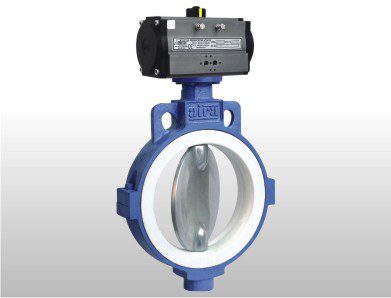
If you’re looking for a reliable, efficient way to control the flow of liquids or gasses, a butterfly valve with an actuator is a great option. But how do you choose the right one for your needs?
In this blog post, we’ll cover everything you need to know about butterfly valves and actuators, including their work, the types available, and the selection criteria you should consider. We’ll also provide tips on maintaining your butterfly valve to keep it in top condition.
So whether you’re a first-time buyer or simply looking for more information, read on for everything you need to know about choosing the suitable butterfly valve with an actuator.
What is Butterfly Valve and Its Working Principle?
A butterfly valve with actuator is a quarter-turn valve that controls the flow of liquids and gasses. The valve gets its name from the butterfly-shaped disc that blocks or allows flow through the valve. Butterfly valves are classified as either lug-type or wafer-type, depending on how they are mounted.
Lug-type butterfly valves have threaded inserts at the body’s top and bottom, allowing them to be bolted in place. Wafer-type butterfly valves have a groove around the circumference of the body that will enable them to be clamped between two pipes.
Butterfly valves are generally used for applications requiring a low pressure drop across the valve. The main advantage of butterfly valves is their compact size and lightweight. Butterfly valves can also be installed in either direction, making them easier to install than other valves.
The working principle of a butterfly valve is relatively simple. When the disk is open, fluid can flow through the valve unobstructed. When the disk is in the closed position, fluid is prevented from flowing through the valve. The disk can be moved between open and closed jobs, allowing precise flow control through the valve.

Why do you need an Actuator for the Butterfly Valve?
An actuator is an essential component of a butterfly valve. It is responsible for opening and closing the valve, as well as regulating the flow of fluid through the valve. Different actuators are available on the market, each with unique features and benefits. When choosing an actuator for a butterfly valve, it is essential to consider the application’s specific needs.
Types of Actuators
There are three main types of actuators: pneumatic, hydraulic and electric.
Pneumatic actuators use compressed air to generate the force to open or close the valve. They are typically used in applications where a clean environment is required, as there is no risk of oil or other fluids leaking from the actuator. Pneumatic actuators are also relatively simple and inexpensive to maintain.
Hydraulic actuators use oil or another fluid to generate the force to open or close the valve. They are often used in applications requiring a high level of detail, such as in industrial settings. Hydraulic actuators can be more complex and expensive to maintain than pneumatic actuators, but they offer higher accuracy and precision.
Electric actuators use an electric motor to generate the force to open or close the valve. They offer high accuracy and precision and can be used in clean and dirty environments. Electric actuators can be more complex and expensive to maintain than pneumatic or hydraulic actuators. Still, they offer several advantages, such as being able to operate at high speeds and being able to reverse direction quickly.
Selection Criteria for Butterfly Valve with Actuator
There are several factors to consider when selecting a butterfly valve with an actuator, including:
1. The fluid type being handled: Different fluids have different properties, so choosing a valve and actuator compatible with the specific fluid is essential. For example, some liquids are corrosive, while others are abrasive.
2. The operating conditions: The application’s functional requirements must be considered when selecting a butterfly valve and actuator. For example, the temperature and pressure of the fluid must be within the range that the valve and actuator can safely handle.
3. The required flow rate: The butterfly valve must be sized appropriately for the required flow rate. If the valve is too small, the flow rate will be restricted; if the valve is too large, the pressure drop across the valve will be excessive.
4. The available space: The butterfly valve must fit in the public space. This includes the physical dimensions of the valve and actuator and any clearance requirements for installation or maintenance.
5. The required level of control: The butterfly valve must offer the necessary level of power for the application. This includes both the precision of control and the necessary range of motion.
How to Maintain Butterfly Valve with Actuator?
Assuming that the butterfly valve with the actuator is installed and functioning correctly, a few maintenance measures should be taken to ensure its longevity:
- It is essential to keep the actuator clean. This can be done by using compressed air to blow off any dirt or debris accumulated on the surface.
- It is essential to lubricate the actuator regularly. This will help prevent wear and tear on the moving parts and keep the actuator working smoothly.
- It is necessary to check the actuator for leaks regularly.
- If any leaks are found, they should be repaired immediately.
These simple maintenance measures ensure that your butterfly valve with an actuator will provide years of trouble-free operation.